

Watching a 3-year-old discover the world is a remarkable experience. Their curiosity is boundless, and their minds are like sponges, soaking up information at an incredible rate. This is a pivotal year for development, as they transition from toddlerhood to the preschool years. One of the most effective ways to support this growth is through play. The right educational toys for 3 year olds can make learning feel like an adventure, helping them build critical skills while they are having fun. This guide will walk you through everything you need to know to choose the perfect toys that will challenge, entertain, and educate your little one.
Key Takeaways
- At age 3, children are developing key cognitive, social, emotional, and motor skills.
- Educational toys are specifically designed to target these developmental areas through play.
- Look for toys that promote problem-solving, creativity, language, and physical coordination.
- Safety is paramount; always choose age-appropriate toys made from non-toxic materials.
- The best toys are those that can grow with your child and offer multiple ways to play.
Understanding a 3-Year-Old’s Developmental Milestones
Before diving into specific toys, it’s helpful to understand what’s happening in a 3-year-old’s world. At this age, children are making huge leaps in several areas. They are starting to understand more complex concepts, their language skills are exploding, and they are becoming more coordinated and physically capable. They are also learning how to play with others, share, and express their feelings. Choosing the best educational toys for 3 year olds means finding items that align with these developmental milestones, providing just the right amount of challenge to keep them engaged without causing frustration.
Cognitive and Problem-Solving Skills
A 3-year-old’s brain is working hard to make sense of the world. They are beginning to understand cause and effect, sort objects by shape and color, and complete simple puzzles. Their memory is improving, and they can follow multi-step instructions. Toys that encourage this type of thinking are essential. Puzzles with larger pieces, simple building blocks, and matching games are fantastic for building foundational cognitive skills. These activities teach them to think critically and solve problems, which are skills they will use for the rest of their lives.
Language and Communication Growth
You have probably noticed that your 3-year-old is talking a lot more! Their vocabulary is expanding rapidly, and they are starting to form more complex sentences. They love to ask “why?” and enjoy listening to stories. Educational toys for 3 year olds that support language development can include picture books, play phones, and puppets. These toys encourage pretend play and storytelling, giving children a chance to practice their communication skills in a fun and imaginative way. Reading to them daily is also one of the most powerful ways to boost their language abilities.
Fine and Gross Motor Skill Development
Motor skills are all about movement. Gross motor skills involve the large muscles used for running, jumping, and climbing. Fine motor skills involve the small muscles in the hands and fingers, used for tasks like drawing, writing, and buttoning a shirt. A 3-year-old is refining both. They can now run more smoothly, kick a ball, and pedal a tricycle. At the same time, they are getting better at holding a crayon and manipulating small objects. Toys that support these skills are crucial for their physical confidence and independence.
Top Categories of Educational Toys for 3 Year Olds
Now that we have covered the key developmental areas, let’s explore the best categories of educational toys for 3 year olds. The goal is to provide a well-rounded “play diet” that touches on all aspects of their growth.
Building Blocks and Construction Toys
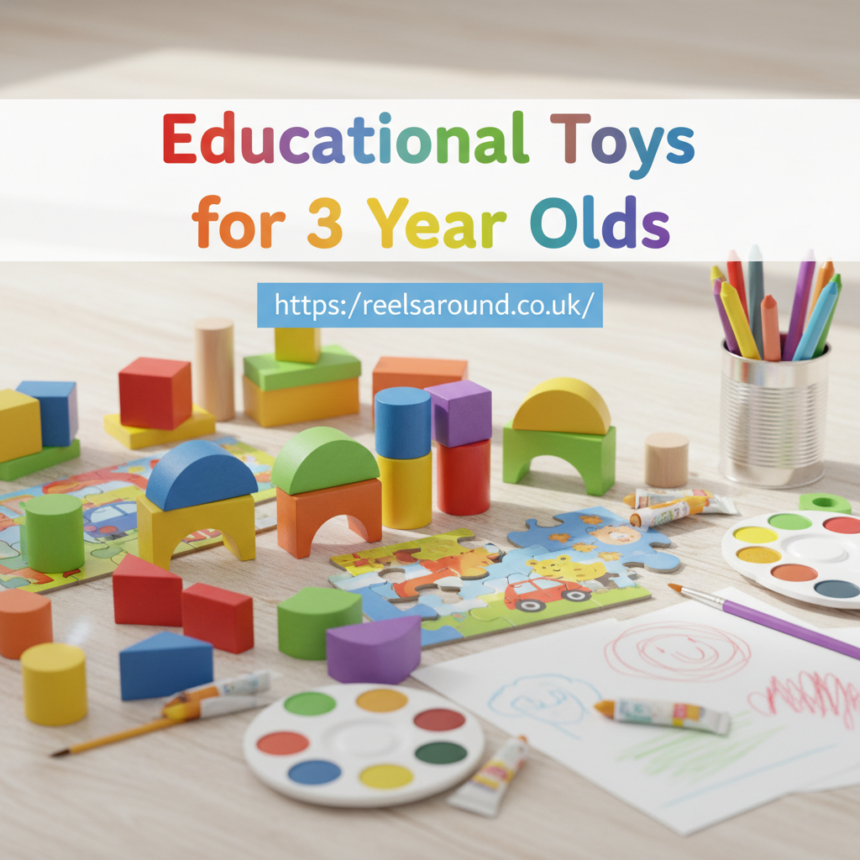
Building blocks are a timeless classic for a reason. They are incredibly versatile and support a wide range of developmental skills. Whether they are simple wooden blocks or interlocking plastic ones, these toys teach spatial awareness, problem-solving, and fine motor skills. As a child stacks blocks, they are learning about balance, gravity, and geometry without even realizing it. This type of open-ended play also fuels creativity, as there is no right or wrong way to build. They can create a tall tower, a long road, or an imaginary castle, all while honing their hand-eye coordination.
Puzzles and Shape Sorters
Puzzles are fantastic brain-boosters for 3-year-olds. They teach patience, persistence, and the satisfaction of completing a task. Start with simple peg puzzles and gradually move to 12-24 piece jigsaw puzzles as their skills improve. Puzzles help with shape recognition, memory, and fine motor control. Shape sorters are another excellent choice, as they challenge a child to match shapes to their corresponding holes. This activity reinforces their understanding of shapes and sizes while promoting problem-solving and hand-eye coordination. Choosing puzzles with vibrant, engaging pictures makes the activity even more appealing.
Arts and Crafts Supplies
Unleash your 3-year-old’s inner artist with a well-stocked craft corner. Crayons, washable markers, finger paints, and modeling clay are perfect educational toys for 3 year olds that encourage creativity and self-expression. Working with these materials helps develop fine motor skills, as they learn to hold a crayon, squeeze a paint bottle, or roll out clay. It’s also a wonderful sensory experience. Don’t worry about the final product; the focus should be on the process of creating. Art provides a healthy outlet for emotions and allows children to communicate their ideas in a visual way.
Pretend Play and Role-Playing Sets
At age three, a child’s imagination is in full swing. Pretend play is more than just fun; it’s how they process the world around them. A play kitchen, a doctor’s kit, or a set of dress-up clothes can provide hours of entertainment while teaching valuable life skills. Through role-playing, children practice social skills like sharing, taking turns, and empathy. They can act out different scenarios, which helps them understand social roles and routines. This type of play also enhances language development as they create narratives and dialogue for their characters.
The Importance of a Play Kitchen
A play kitchen is one of the most beneficial educational toys for 3 year olds. It allows them to mimic the activities they see adults do every day. This mimicry is a powerful form of learning. While “cooking,” they can practice sorting (fruits vs. vegetables), counting (three carrots), and following sequences (first, wash the lettuce, then put it in the bowl). It also opens up opportunities for imaginative play with friends or family, fostering cooperation and communication.
The STEM Advantage: Early Science and Math Toys
It’s never too early to introduce concepts of Science, Technology, Engineering, and Math (STEM). For a 3-year-old, this doesn’t mean complex equations or lab experiments. It means fostering curiosity and logical thinking through play.
Simple Science Kits
Look for age-appropriate science kits that focus on exploration. A magnifying glass for observing bugs and leaves, a set of magnets to explore attraction and repulsion, or simple water play toys can introduce basic scientific principles in an accessible way. These activities encourage observation, questioning, and experimentation. They teach children to be curious about how things work, laying a strong foundation for future scientific learning. The goal is to nurture their natural sense of wonder about the world.
Early Math and Counting Toys
Math skills at this age are all about hands-on learning. An abacus, colorful counting bears, or large number puzzles are great educational toys for 3 year olds that make math tangible. These toys help them understand one-to-one correspondence (one bear for the number one), number recognition, and basic sorting. Board games with dice are also excellent for practicing counting in a fun, social context. Integrating numbers and counting into everyday play helps build a positive and confident attitude toward math from a young age.
Choosing Safe and Durable Toys
Safety should always be the top priority when selecting toys for any child. For 3-year-olds, who may still occasionally put things in their mouths, this is especially critical.
Key Safety Considerations
Here are some important safety checks to make before purchasing a toy:
- Non-Toxic Materials: Ensure toys are made from non-toxic, BPA-free, and lead-free materials. Look for labels that confirm safety standards.
- Choking Hazards: Avoid toys with small parts that could break off and become a choking hazard. A good rule of thumb is that any part that can fit through a toilet paper tube is too small.
- Durable Construction: Check for sturdy construction. Toys should be able to withstand rough play without splintering, cracking, or breaking into sharp pieces.
- Age Appropriateness: Always adhere to the manufacturer’s age recommendations. These guidelines are based on a child’s developmental abilities and potential safety risks.
Comparing Toy Materials
|
Material |
Pros |
Cons |
Best For |
|---|---|---|---|
|
Wood |
Durable, non-toxic (if properly finished), classic feel, sustainable. |
Can be heavy, may splinter if poor quality. |
Blocks, puzzles, play food, vehicles. |
|
Plastic |
Lightweight, easy to clean, often less expensive, can be molded into complex shapes. |
Environmental impact, check for BPA-free, can break and create sharp edges. |
Building sets, role-playing toys, water toys. |
|
Fabric/Plush |
Soft, safe, comforting, great for imaginative play. |
Can be difficult to clean, may harbor dust mites. |
Dolls, puppets, dress-up clothes, play mats. |
The Role of Play in Social and Emotional Learning
Play is a child’s first classroom for social and emotional skills. The right educational toys for 3 year olds can facilitate this learning by encouraging interaction, cooperation, and emotional expression. When children play together, they learn to negotiate, share, and resolve conflicts. They learn to see things from another person’s perspective, which is the foundation of empathy. Toys like board games teach them about taking turns and being a gracious winner or loser. Puppets and dolls can be used to act out feelings, helping children understand and manage their own emotions.
Final Thoughts: Fostering a Lifelong Love of Learning
The toys a child plays with during their formative years can have a lasting impact. By choosing high-quality educational toys for 3 year olds, you are not just giving them something to do; you are providing them with the tools they need to build a strong foundation for future learning. The most important thing is to be involved. Play with your child, ask them questions, and celebrate their discoveries. Your engagement turns a simple toy into a powerful learning experience. The goal is to nurture their natural curiosity and help them see that learning is an exciting adventure.
For more interesting reads on a variety of topics, you might want to explore some of the articles at reelsaround.co.uk. The principles of play and learning are fundamental to human development, a concept explored in depth by psychologists and educators for generations. You can learn more about the history and theory behind this on a platform like Wikipedia, which has extensive resources on the topic of play in child development.
Frequently Asked Questions (FAQ)
Q: How many toys does a 3-year-old really need?
A: Quality over quantity is key. A small, curated collection of open-ended toys is more beneficial than a room full of flashy, single-use gadgets. Try a toy rotation system, where you store some toys away and switch them out every few weeks to keep them feeling fresh and exciting.
Q: Are electronic toys with lights and sounds educational?
A: While some electronic toys can be educational, they should be used in moderation. Often, the most educational toys are the simplest ones that require a child to use their own imagination. Overly stimulating toys can sometimes hinder creative thinking. Look for electronics that are interactive and respond to a child’s input rather than just performing for them.
Q: What are the best educational toys for 3 year olds to encourage independent play?
A: Open-ended toys like building blocks, modeling clay, and art supplies are excellent for fostering independent play. Puzzles are also a great choice. These toys allow a child to become absorbed in an activity at their own pace, which builds concentration and self-confidence.
Q: How can I make screen time more educational for my 3-year-old?
A: If you choose to allow screen time, make it active and engaging. Co-watch with your child, ask questions about what’s happening, and choose high-quality, age-appropriate apps and programs designed for learning. Look for content that encourages problem-solving and creativity.
Q: My 3-year-old gets frustrated with puzzles. How can I help?
A: Start with very simple puzzles, like 3-4 piece peg puzzles, to build their confidence. Work on the puzzle together, demonstrating strategies like finding the corner pieces first. Offer encouragement but don’t solve it for them. The goal is to teach them persistence and the satisfaction of working through a challenge. Celebrate their effort, not just the completion.