

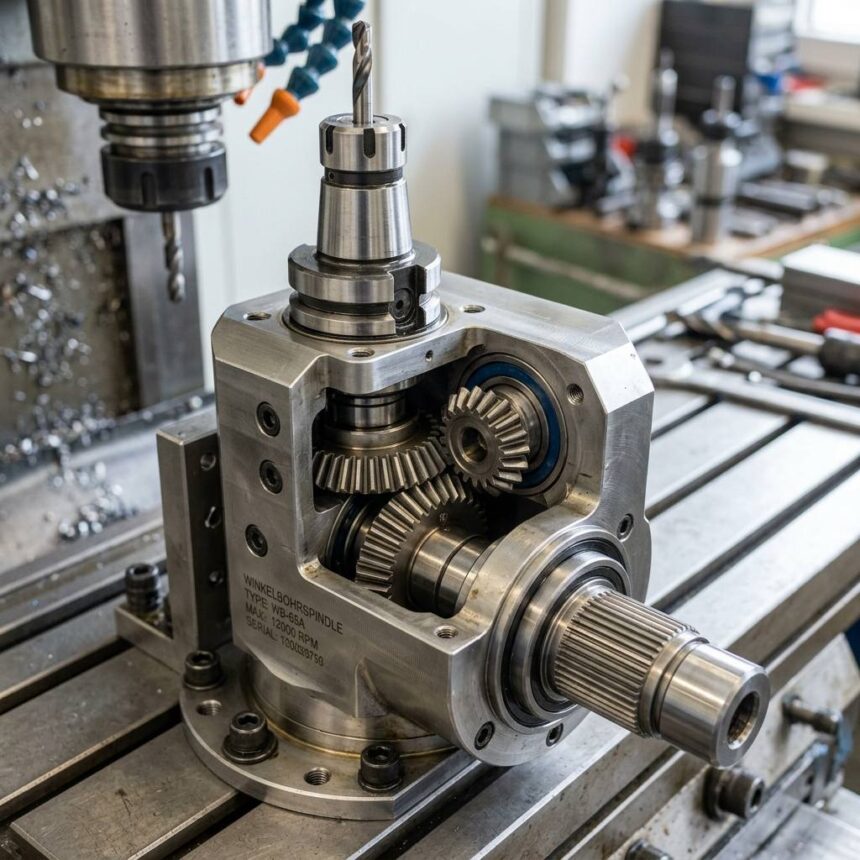

A Winkelbohrspindel is a smart solution for angled drilling, milling, and tapping when a straight spindle cannot reach the work area. It redirects rotational motion through a gear system, usually with bevel gears, so machines can work at fixed or adjustable angles with high precision.
This article explains how a Winkelbohrspindel works, where it is used, and why it matters in CNC machining, precision engineering, woodworking, and metalworking. You will also see its main types, technical points, limits, maintenance needs, and its role in Industry 4.0 and smart factories.
Understanding Winkelbohrspindel
The term Winkelbohrspindel refers to an angled drilling spindle designed to transfer power from the machine spindle to an output spindle set at another angle. In most cases, the common angle is 90 degrees, which helps reach side faces, corners, and tight sections of a part.
It became important as factories moved toward faster production, multi-face machining, and work on complex geometries. Today, the Winkelbohrspindel is widely used in machining centers, production equipment, and robotic machining systems where access, speed, and repeatability are critical.
| Feature | Winkelbohrspindel | Standard Straight Spindle |
| Primary Function | Angled drilling, side drilling, cross-machining | Straight-line drilling and milling |
| Common Working Angle | 90 degrees or adjustable | 0 degrees |
| Core Mechanism | Bevel gears or hypoid gears | Direct spindle alignment |
| Best Use Case | Confined spaces and side access | Open, front-facing machining |
| Tool Holding Options | ER25, ER collets, HSK, BT, ISO tapers | Standard machine spindle tooling |
| Speed Range | Up to 13,000 RPM in some models | Varies by machine |
| Torque Performance | Good for targeted side work and torque transfer | Strong for direct-axis work |
| Typical Industries | Automotive industry, aerospace industry, woodworking, metal fabrication | General machining |
| Productivity Benefit | Less repositioning, lower setup time | More setups in angled jobs |
| Design Focus | Compact design, access, flexibility | Simplicity and direct power |
Definition and Origin
A Winkelbohrspindel is an attachment or spindle unit that changes the direction of spindle power for machining at an angle. The idea grew from the need to machine features that are difficult to reach with a normal spindle.
Its development followed the rise of advanced CNC systems and the demand for better access in metalworking and precision engineering. As parts became more complex, this spindle design became a practical answer.
Key Components and Mechanism
Most units include an input shaft, output spindle, housing, gear system, bearings, and a tool holding system. The heart of the design is the gear set, often based on bevel gears, that redirects power without losing control.
The spindle receives motion from the machine, passes it through the gears, and delivers it to the cutting tool. With proper lubrication and alignment, it can handle drilling, tapping, and light milling with strong repeatability.
What is a Winkelbohrspindel?
A Winkelbohrspindel is best described as a precision attachment that lets a machine cut or drill from the side instead of only from the front. This simple change in direction opens new options in CNC machining, especially when working in deep pockets, around frames, or inside assembled structures.
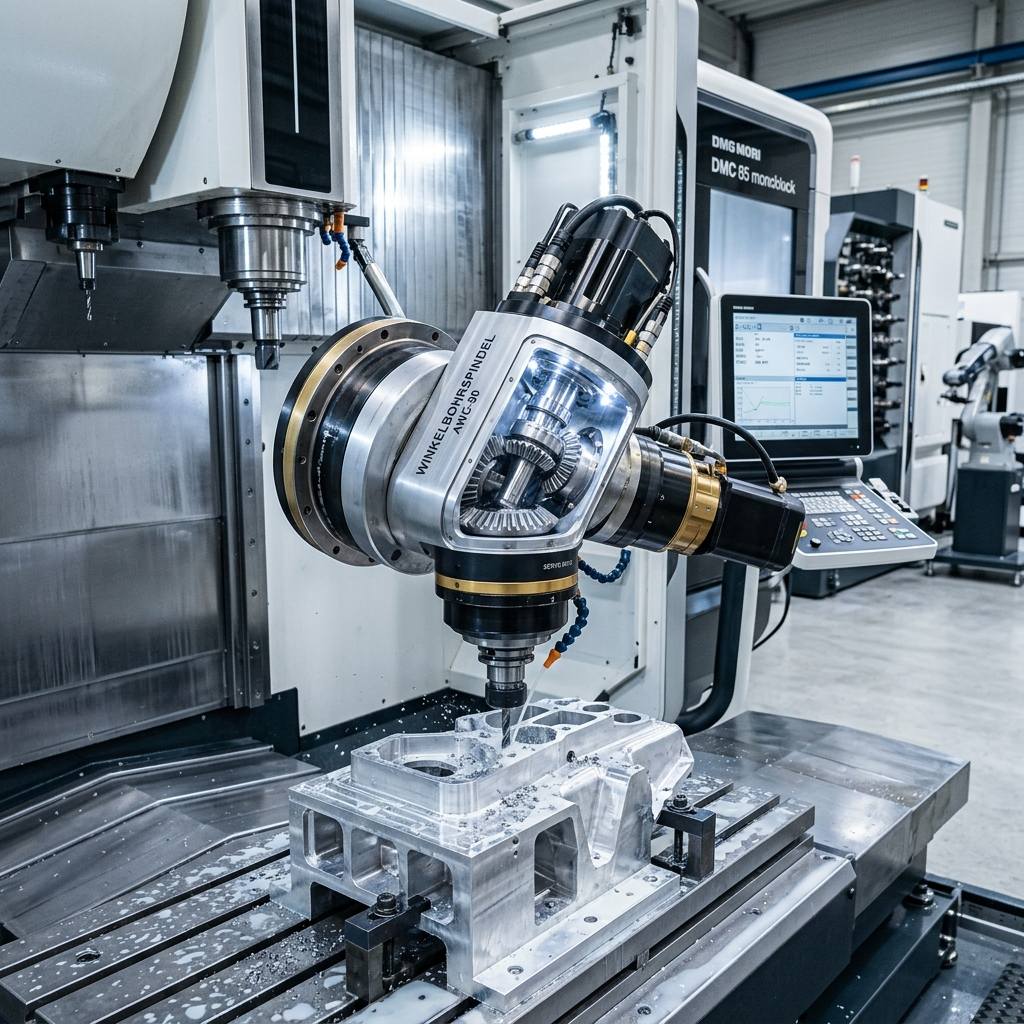
For manufacturers, it is not just a special tool but a productivity device. By reducing part repositioning and allowing side drilling or angled joints in one setup, the Winkelbohrspindel supports faster workflows and better use of machine time.
Importance in Modern Manufacturing
Modern manufacturing depends on speed, accuracy, and fewer interruptions between operations. A Winkel bohr spindel helps by reaching hard areas without moving the part again and again.
That matters in sectors where every second of machine time counts. It improves production efficiency, supports automation, and fits well into high-output industrial workflows.
Role in Complex Machining Tasks
Many components have holes, faces, and joining points placed on different sides of the same part. A standard tool may need several setups to finish them, which adds time and risk.
An angled spindle reduces that burden by reaching hidden faces with better control. This is especially useful in cross-machining, decorative machining, and parts with hidden fastener paths.
Types of Winkelbohrspindel
There is no single design that fits every factory need, so the market offers several Winkelbohrspindel variants. Each type is built around a specific balance of angle, speed, torque, size, and application range.
Choosing the right type depends on material, machine interface, cutting speed, and access limits. Whether the job involves aluminum, steel, titanium, plastics, or cast iron, the spindle must match the process and the tool path.
Fixed-Angle Winkelbohrspindel
A fixed-angle model is set at one working angle, often 90 degrees, and is valued for stability and repeatable performance. It is common in production lines where the same task repeats many times.
Because the geometry does not change, the design is often stronger and simpler to maintain. This makes it a reliable option for standard side drilling and repetitive machining cycles.
Adjustable-Angle Winkelbohrspindel
An adjustable-angle unit lets the operator set different working positions based on the part design. This flexibility helps when a shop handles varied jobs or prototypes with changing hole directions.
It is useful in custom machining and low-volume work, though it may require more careful setup. Even so, it gives manufacturers wider process freedom on one machine.
Multi-Spindle Winkelbohrspindel
A multi-spindle version is designed to run more than one tool position at a time. It is often used where several holes must be made in one cycle to reduce total machining time.
This design supports high-volume manufacturing and improves consistency across repeated parts. It is a strong fit for industrial lines focused on output and repeatability.
High-Speed Winkelbohrspindel
A high-speed model is built for rapid spindle rotation, with some units reaching up to 13,000 RPM. These spindles are useful for lighter cuts, smaller tools, and materials that benefit from fast, clean machining.
They are often chosen for aluminum, plastics, and fine finishing operations. Good balance, cooling, and low vibration are especially important at these speeds.
High-Torque Winkelbohrspindel
A high-torque spindle favors power over extreme speed and is suitable for tougher materials and demanding cuts. It performs well in drilling or tapping jobs where cutting resistance is high.
This type is often selected for steel, cast iron, and heavy-duty operations. A robust gear system is essential to manage the extra load and maintain precision.
Compact Winkelbohrspindel
A compact design is made for tight spaces where a larger spindle body cannot fit. This style helps in confined spaces, narrow cavities, and machine setups with limited clearance.
Its smaller footprint makes it valuable in detailed work and machines with crowded work zones. Despite the size, a good compact spindle still delivers solid accuracy and dependable access.
Applications Across Industries
The value of the Winkelbohrspindel becomes clear when you look at real production settings. Its ability to work around corners and machine multiple faces makes it useful in industries that deal with complex parts and strict tolerances.
From mass production to custom fabrication, this spindle supports better access and cleaner workflows. It is used in sectors where a missed angle or extra setup can increase cost, delay output, or reduce part quality.
Automotive Industry
In the automotive industry, side drilling and angled machining are common in engine parts, transmission housings, brackets, and structural assemblies. A Winkel bohr spindel helps machine hidden holes and angled features without extra repositioning.
This supports faster cycle times and better consistency in large production runs. It also helps with multi-face machining in parts that must meet close dimensional standards.
Aerospace Industry
The aerospace industry works with demanding materials and strict precision targets, so access tools matter a great deal. An angled spindle helps machine hard-to-reach faces on lightweight but complex components.
It is especially useful when working with titanium and high-value structural parts. Reducing setup changes also lowers handling risk on expensive workpieces.
Woodworking and Furniture Manufacturing
In woodworking and furniture production, angled holes are often needed for fittings, hidden joints, and clean assembly. A Winkel bohr spindel helps create accurate holes for hidden fastener holes and neat angled connections.
It also supports decorative machining where the tool must approach from a side face. This improves finish quality and reduces manual correction later.
Metal Fabrication
In metal fabrication, shops often deal with frames, enclosures, tubes, and formed parts that limit direct access. An angled spindle allows drilling and tapping in places that would otherwise need special fixtures or manual work.
That means lower setup time and smoother workflow on varied jobs. It is particularly useful when handling short runs with changing designs.
CNC Machining Centers
Modern machining centers benefit from angled spindle attachments because they expand what a single machine can do. The ability to drill from the side increases machine flexibility without adding another dedicated station.
This is why many advanced CNC systems include support for spindle attachments and interface standards like HSK, BT, and ISO tapers. The result is a broader process range with less downtime.
Advantages of Winkelbohrspindel
The main reason manufacturers choose a Winkelbohrspindel is simple: it solves access problems while improving workflow. But the benefits go beyond reach, touching productivity, cost control, quality, and machine utilization.
When matched correctly to the job, it becomes a practical tool for reducing wasted motion in the shop. This is why it is now seen as a value-driving part of advanced machining rather than a niche accessory.
Improved Accessibility
Some features sit deep inside a part or on a face blocked by clamps, walls, or nearby geometry. A Winkel bohr spindel gives the tool a better approach path without changing the entire setup.
That access can make impossible jobs possible on existing equipment. It is a direct solution for side features and awkward drilling positions.
Reduced Setup Time
Every time a part is unclamped and turned, the process slows down and the risk of error rises. An angled spindle cuts down those extra steps by reaching more faces in one clamping.
This saves time across both short and long production runs. It also helps operators maintain a smoother and more predictable routine.
Increased Productivity
Fewer setups mean faster throughput and less idle machine time. Shops can complete more operations in a single cycle, which improves daily output.
That gain becomes significant in repetitive production where seconds matter. Over time, the spindle can support strong overall cost efficiency.
High Precision and Repeatability
A properly built spindle with quality gears and bearings offers consistent motion transfer and accurate tool positioning. This is critical for hole location, surface quality, and repeatable dimensions.
In production environments, repeatability matters just as much as raw speed. A stable angled spindle helps keep parts within target over many cycles.
Versatility and Cost Efficiency
One machine equipped with the right spindle attachment can handle jobs that might otherwise need special fixtures or separate machines. That gives shops more flexibility without a full equipment change.
For many operations, this improves return on investment. It also allows a wider service range for job shops and contract manufacturers.
Technical Specifications to Consider
Before selecting a Winkelbohrspindel, manufacturers must look beyond the angle itself. Speed, torque, interface compatibility, tool holding, and overall spindle weight all affect how well the unit performs in real production.
Technical details also influence machine safety and tool life. A spindle that looks suitable on paper may fail in practice if its load capacity, gear ratio, or interface does not match the application.
Maximum RPM and Torque
Some spindles are optimized for speed, while others are designed for stronger torque transfer. Depending on the model, values may range from 2,700 RPM to 5,400 RPM or even 13,000 RPM for high-speed applications.
Power ratings such as 1.1 kW help define what the unit can handle. The correct choice depends on material, tool size, and whether the work involves drilling, tapping, or milling.
Gear Ratio and Tool Holding Systems
The gear ratio affects output speed and torque, with examples like a 1:2 gear ratio used in specialized setups. A well-matched gear design keeps the spindle efficient and protects it from overload.
Tool holding matters just as much, with options such as ER collets, ER25, HSK, BT, and ISO tapers. The right holder improves grip, balance, and changeover speed.
Mounting Interface Compatibility
A spindle must fit the machine’s mounting interface correctly or it will not perform safely. Connection standards, alignment points, and fastening sizes all need careful review before use.
Some units may include dimensional references like Ø8H7, Ø10H7, M8, M10, or tool diameter support up to Ø16 mm. Weight can also matter, with some assemblies around 10.5 kg affecting handling and machine load.
Challenges and Limitations
Even though a Winkelbohrspindel offers clear benefits, it is not the perfect answer for every machining task. Like any precision tool, it works best when users understand both its strengths and its operating limits.
Ignoring those limits can shorten tool life, reduce accuracy, or create maintenance problems. That is why buyers should judge performance by application fit, not just by spindle speed or price.
Speed and Torque Constraints
Because power changes direction through gears, some loss and load limits are expected. A spindle built for speed may not handle heavy cuts, while a torque-focused unit may not suit fine, high-speed work.
Matching spindle design to the task is essential. Running outside the intended range can raise heat, wear, and accuracy issues.
Maintenance Requirements
These spindles contain moving parts that need regular care, especially gears, bearings, and seals. Poor maintenance can quickly affect precision and noise levels.
Operators need a clear service routine to protect performance. This includes lubrication checks, cleaning, and inspection after heavy use.
Higher Initial Costs
A quality angled spindle often costs more than simpler attachments because of its design complexity and precision parts. That can raise the starting investment for smaller shops.
Still, cost should be measured against saved setup time and broader machine capability. In many cases, the long-term value offsets the purchase price.
Maintenance and Best Practices
A Winkelbohrspindel performs best when treated as a precision asset rather than a simple accessory. Regular upkeep protects the gear train, supports smooth motion, and prevents small issues from growing into expensive machine stoppages.
Good maintenance also improves process stability over time. In high-output environments, even minor gains in reliability can make a strong difference in productivity and part quality.
Lubrication and Cleaning
Proper lubrication reduces friction in gears and bearings while helping manage heat during operation. The correct lubricant and interval should always match the maker’s guidance and the spindle’s working load.
Cleaning is just as important because chips and coolant residue can damage seals and contact points. A clean spindle stays more accurate and lasts longer in daily use.
Vibration and Noise Monitoring
Changes in vibration or noise often warn of wear, imbalance, or alignment problems. Shops that monitor these signals can catch issues before serious damage occurs.
This matters even more in high-speed units. Early detection supports safer running and avoids sudden downtime in production.
Periodic Inspections
Routine inspection should cover gears, tool holders, fasteners, and interface surfaces. Operators should also look for signs of overheating, play, or unusual resistance during rotation.
Simple checks can prevent bigger failures later. A short inspection routine is a smart habit in any professional machining environment.
Future of Winkelbohrspindel Technology
The next phase of Winkelbohrspindel development is tied closely to smarter machines and tighter production demands. Manufacturers want compact tools that work faster, share data, and support flexible automation without adding complexity.
This shift is pushing spindle makers toward better materials, more efficient gear designs, and stronger digital integration. As a result, the angled spindle is becoming a more connected part of modern factory systems.
Integration with Industry 4.0
As factories adopt Industry 4.0, tooling is expected to support data-based decisions and machine-to-system communication. A modern angled spindle can fit into this environment through better monitoring and process visibility.
That makes it easier to track performance trends and service needs. It also helps production teams improve uptime and planning.
Smart Monitoring Systems
New systems are adding sensors for temperature, load, and vibration monitoring to detect problems early. This supports preventive maintenance instead of waiting for a breakdown.
In smart factories, that data can be linked to wider machine health systems. The result is a more reliable and controlled machining process.
Compact and Efficient Designs
Space is always valuable in machine tools, so builders continue to improve compact design without sacrificing output. Smaller housings, lighter materials, and better internal geometry all support this trend.
Efficient designs also reduce wasted power and improve handling. This is useful in both fixed machine setups and robotic machining systems.
Case Studies
Real-world use shows that the Winkelbohrspindel is more than a specialty tool for unusual jobs. It has become a practical asset in industries that need side access, stable quality, and reduced setup time across complex production tasks.
The strongest case studies usually come from operations where access limits once caused delays or added fixture changes. In those settings, the spindle often improves both process flow and output consistency.
Success Stories in Automotive and Aerospace Industries
In automotive lines, angled spindles have helped machine side holes in housings and support parts in fewer operations. This reduces handling time and improves repeatability across large batches.
In aerospace work, they have supported safer machining on costly parts with complex faces. Better access means fewer setup risks and more controlled cutting on high-value materials.
Innovations in CNC Machining
Advanced CNC machining continues to expand spindle use through better interfaces, digital setup support, and stronger machine compatibility. Shops can now integrate angled machining into more routine processes instead of treating it as an exception.
This has made the technology easier to adopt. It also supports flexible manufacturing strategies where one machine handles many part styles.
Conclusion
A Winkelbohrspindel has earned its place in modern manufacturing because it solves a common and costly problem: poor access to angled or side-facing features. By redirecting spindle power through precision gears, it enables drilling, tapping, and milling where standard tools often struggle.
Its value is clear across automotive, aerospace, woodworking, metal fabrication, and advanced CNC machining centers. When chosen carefully and maintained well, it improves accessibility, repeatability, productivity, and long-term efficiency.
Why Winkelbohrspindel is Indispensable
Manufacturers need tools that help them do more with the machines they already own. An angled spindle expands capability without forcing a full process redesign.
That is why it is becoming indispensable in precision workflows. It saves time, improves reach, and supports higher-value machining.
Final Thoughts on Its Role in Modern Manufacturing
The future of machining will keep moving toward flexibility, data, and tighter process control. The Winkelbohrspindel fits that future because it adds both mechanical function and production value.
For shops aiming to improve access and reduce wasted setups, it remains a highly practical investment. Its role in modern manufacturing will only grow stronger.