
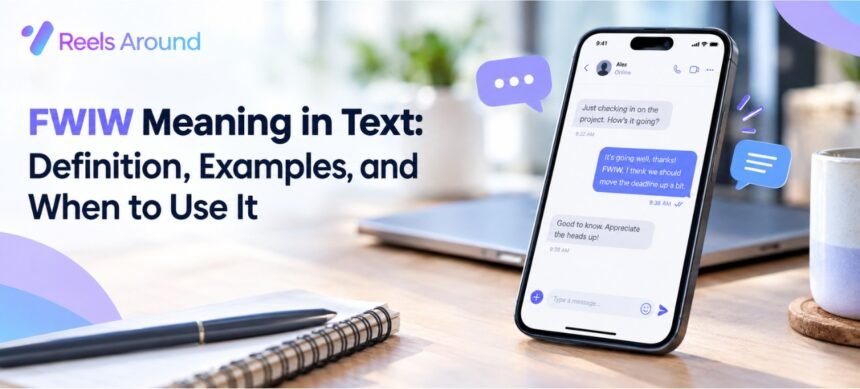

Have you ever received a text that starts with “FWIW” and wondered what the sender was trying to say? This four-letter abbreviation appears in text messages, online discussions, social media comments, and workplace chats. Although it looks unusual at first, its meaning is simple once you understand the phrase behind it.
- What Does FWIW Mean?
- FWIW Meaning in Text Messages and Online Chats
- How to Use FWIW Correctly
- FWIW Examples in Everyday Conversations
- What Tone Does FWIW Convey?
- Is FWIW Rude or Disrespectful?
- FWIW vs. IMO, IMHO, TBH, and FYI
- Can You Use FWIW in Professional Emails?
- How Do You Reply When Someone Uses FWIW?
- Where Did FWIW Come From?
- Frequently Asked Questions About FWIW Meaning
- Final Thoughts
FWIW stands for “For What It’s Worth.” People use it before sharing an opinion, personal experience, suggestion, or piece of information that might be helpful to someone else. It often makes a statement sound less forceful and gives the reader room to agree or disagree.
In this guide, you’ll learn the FWIW meaning in text, how people use it in everyday conversations, what tone it can convey, and when it is appropriate to use professionally.
What Does FWIW Mean?
FWIW is short for “For What It’s Worth.” It is an informal written abbreviation used when someone wants to contribute a thought without suggesting that their opinion is the final answer.
In simple English, it can mean something like “This might help,” “Here’s my perspective,” or “Take this into consideration if you find it useful.”
For example:
- “FWIW, I think the first option is better.”
- “FWIW, the shop usually offers discounts on weekends.”
- “FWIW, I had a similar experience last year.”
Each sentence introduces information or a viewpoint without demanding that the other person accept it.
The expression does not automatically mean the information is unimportant. Instead, it acknowledges that the value of a comment depends on the situation and the person receiving it.
FWIW Meaning in Text Messages and Online Chats
In text messages, FWIW is often used to introduce an opinion or suggestion in a relaxed way. Since written conversations lack facial expressions and vocal tone, a direct statement can sometimes sound harsher than intended.
Adding FWIW can make the message feel more considerate, although the surrounding words still matter.
Why Do People Use FWIW?
People commonly use this abbreviation to:
- Share an opinion: Explain what they think without sounding overly certain.
- Offer advice: Suggest an option while leaving the decision to someone else.
- Add useful information: Mention a detail that could help another person.
- Reduce tension: Introduce a different perspective during a disagreement.
- Share personal experience: Explain what worked for them in a similar situation.
For example, imagine your friend is choosing between two phones. You could say, “FWIW, my older model still works well.”
You are sharing your experience, not claiming that your preferred phone is automatically the best choice.
FWIW can appear in SMS messages, WhatsApp chats, direct messages, online forums, gaming conversations, and social media discussions. Its exact tone depends on the context.
How to Use FWIW Correctly
The easiest way to use FWIW is to place it at the beginning of a sentence before the opinion or information you want to share. It is commonly followed by a comma.
Here are several examples of natural usage.
1. When Sharing an Opinion
Use FWIW when you want to express a personal preference without making it sound like a universal fact.
Example: “FWIW, I prefer the original version of the song.”
This tells the reader that you are sharing your preference rather than declaring that everyone should feel the same way.
2. When Giving Advice
The abbreviation can introduce a suggestion without making the other person feel pressured.
Example: “FWIW, I’d wait until tomorrow before sending that email.”
The speaker offers advice, but the recipient remains free to make their own decision.
3. When Sharing Personal Experience
FWIW is useful when your experience might help someone facing a similar situation.
Example: “FWIW, restarting the router fixed the same problem for me.”
The comment provides a possible solution without promising that it will work for everyone.
4. When Disagreeing Politely
You can use FWIW to introduce a different viewpoint during a discussion.
Example: “FWIW, I understood the instructions a little differently.”
This sounds less confrontational than directly telling someone they misunderstood something. However, tone and wording still determine whether the message feels respectful.
5. In Casual Workplace Conversations
FWIW can also appear in informal professional messages.
Example: “FWIW, the client seemed more interested in the second proposal.”
The sender contributes an observation that colleagues can consider when making a decision.
FWIW Examples in Everyday Conversations
The following examples show how the abbreviation works in different situations.
| Situation | Example message | Intended meaning |
|---|---|---|
| Friendship | “FWIW, you handled that really well.” | Offering reassurance |
| Shopping | “FWIW, this model lasted me three years.” | Sharing personal experience |
| Movies | “FWIW, the book is better than the film.” | Expressing a preference |
| Technology | “FWIW, the latest update fixed my issue.” | Sharing useful information |
| Travel | “FWIW, the earlier train was less crowded.” | Offering a helpful observation |
| Work | “FWIW, I think the shorter headline is clearer.” | Giving constructive feedback |
| Discussion | “FWIW, there’s another way to look at this.” | Introducing another perspective |
These examples illustrate an important point: FWIW does not change the basic meaning of the sentence. It changes how the speaker introduces the information.
What Tone Does FWIW Convey?
Although FWIW has a relatively neutral meaning, it can sound different depending on the conversation.
Friendly and Supportive
“FWIW, I think you made the right decision.”
Here, the abbreviation introduces encouragement and reassurance.
Neutral and Informative
“FWIW, the meeting has been moved to Thursday.”
The sender is simply passing along a detail that may be useful.
Cautious or Modest
“FWIW, I’m not an expert, but this approach worked for me.”
The writer acknowledges the limits of their experience before offering advice.
Critical or Sarcastic
“FWIW, I already mentioned that yesterday.”
Depending on the relationship and previous messages, this could sound frustrated or sarcastic rather than helpful.
Remember: FWIW does not guarantee a polite tone. If the sentence that follows is insulting or dismissive, the abbreviation will not automatically make it respectful.
Is FWIW Rude or Disrespectful?
No. FWIW is not inherently rude. In many conversations, it helps introduce an opinion without sounding too forceful.
However, context matters. A supportive message such as “FWIW, I believe you did your best” is likely to sound encouraging. By contrast, “FWIW, nobody asked for your opinion” can sound dismissive.
If you receive FWIW in a message, consider the complete sentence, the sender’s usual communication style, and the subject being discussed before assuming a negative intention.
It is usually better to interpret the entire message rather than judge the abbreviation alone.
FWIW vs. IMO, IMHO, TBH, and FYI
FWIW belongs to the wider group of internet and texting abbreviations. Several related expressions serve similar purposes, but they are not interchangeable in every situation.
| Abbreviation | Full form | Main purpose |
|---|---|---|
| FWIW | For What It’s Worth | Offers an opinion or information for consideration |
| IMO | In My Opinion | Clearly identifies a personal opinion |
| IMHO | In My Humble Opinion | Introduces an opinion in a modest way |
| TBH | To Be Honest | Signals frankness or honesty |
| FYI | For Your Information | Passes along information someone may need |
| IDK | I Don’t Know | Expresses uncertainty or a lack of knowledge |
What Is the Difference Between FWIW and IMO?
IMO directly signals that a statement represents someone’s opinion. FWIW more often introduces a thought, experience, or piece of information that the reader may find useful.
Compare these messages:
- “IMO, the second design looks better.”
- “FWIW, the second design received more positive feedback.”
The first expresses a personal preference. The second shares an observation that may help someone make a decision.
What Is the Difference Between FWIW and FYI?
FYI is generally used to pass along information, while FWIW often introduces an opinion, suggestion, or experience.
For example:
- “FYI, the deadline is Friday.” This communicates a practical detail.
- “FWIW, I think we should finish the draft by Wednesday.” This offers a recommendation.
Understanding these differences makes online messages easier to interpret.
Can You Use FWIW in Professional Emails?
Yes, but it depends on the workplace, audience, and level of formality.
FWIW can work well in casual team chats, informal emails, brainstorming sessions, and conversations with colleagues who regularly use abbreviations.
For example:
“FWIW, the shorter version of the presentation seemed easier for the team to follow.”
This is a reasonable way to contribute feedback in a relaxed work environment.
However, in formal reports, legal documents, academic writing, client proposals, or official correspondence, it is usually better to write the complete phrase or express the idea directly.
Instead of writing:
“FWIW, I recommend reviewing the figures again.”
You could write:
“Based on my review, I recommend checking the figures again.”
The second version is more direct and suitable for formal communication.
When in doubt, consider your reader and choose language that makes your meaning clear.
How Do You Reply When Someone Uses FWIW?
You do not need a special response just because someone uses this abbreviation. Reply to the opinion, advice, or information that follows it.
Here are a few natural responses:
- If the information helps: “Thanks, that’s useful to know.”
- If you agree: “I was thinking the same thing.”
- If you disagree: “I understand your point, but I see it differently.”
- If someone shares an experience: “That’s interesting. I had a similar experience.”
- If the advice gives you something to consider: “Thanks for the suggestion. I’ll think about it.”
For example:
Person A: “FWIW, I’d choose the earlier flight because delays are less common in my experience.”
Person B: “Good to know. I’ll compare both options before booking.”
This response acknowledges the suggestion without requiring the recipient to agree immediately.
Where Did FWIW Come From?
The full phrase “for what it’s worth” existed in English before modern texting became common. The abbreviation developed as part of the shorter written expressions used in digital communication.
As email, chat rooms, online forums, and instant messaging became more common, abbreviations offered a convenient way to communicate quickly.
Today, FWIW remains recognizable in many online settings, including discussions where people share opinions, experiences, and advice.
To explore the wider history and use of abbreviated expressions online, see Wikipedia’s article on Internet slang.
Although digital language continues to change, established abbreviations such as FWIW remain useful because they communicate a familiar idea in just four letters.
Frequently Asked Questions About FWIW Meaning
What does FWIW stand for in texting?
FWIW stands for “For What It’s Worth.” It is commonly used before an opinion, suggestion, personal experience, or piece of information that might be useful to the recipient.
What does FWIW mean when a girl or guy texts it?
The meaning is the same regardless of who sends it. The person may be sharing an opinion, offering advice, or adding information. The exact intention depends on the message and relationship.
Does FWIW mean the information is not important?
No. It does not mean the information has no value. Instead, it introduces a comment that the sender believes may be worth considering, even if it is not essential.
Is FWIW formal or informal?
FWIW is primarily an informal written abbreviation. It is common in texting, online discussions, and casual workplace communication, but spelling out the phrase is generally more suitable for formal documents.
Should FWIW be uppercase or lowercase?
Both FWIW and fwiw are understandable. Uppercase is common in general writing, while lowercase often appears in casual chats. The meaning remains unchanged.
Is FWIW the same as IMO?
No. IMO means “In My Opinion” and explicitly identifies a personal viewpoint. FWIW means “For What It’s Worth” and often introduces an opinion or detail for someone to consider.
Is FWIW still used online?
Yes. It remains a recognized abbreviation in digital communication, including messages, forums, social media discussions, and informal emails.
Final Thoughts
Understanding the FWIW meaning in text helps you interpret messages more accurately and communicate your own thoughts more naturally. The abbreviation stands for “For What It’s Worth” and is generally used to introduce an opinion, suggestion, or observation without insisting that others agree.
You can use it when sharing personal experiences, offering feedback, or contributing another perspective to a discussion. It works particularly well in casual messages, although clear and direct wording is usually preferable in formal professional writing.
The most important thing is to consider the context. FWIW can sound friendly, neutral, cautious, or even sarcastic depending on the words around it. Once you understand that distinction, this common abbreviation becomes much easier to recognize and use.
Read More: Mastering Droven.io Cloud Computing: A Comprehensive Guide for 2026